
Welcome to the Porifera subsite on Invertebrate Paleontology!
Please enter a genera name to retrieve more information.
Amblysiphonella
Classification
Phylum:
Porifera
Subphylum:
Gelatinosa
Class:
Demospongea
Subclass:
Ceractinomorpha
Order:
Agelasida
Family:
Sebargasiidae
Formal Genus Name and Reference:
Amblysiphonella STEINMANN, 1882, p. 169
Type Species:
A. barroisi STEINMANN, 1882, p. 170, OD
Images
(Click to enlarge in a new window)
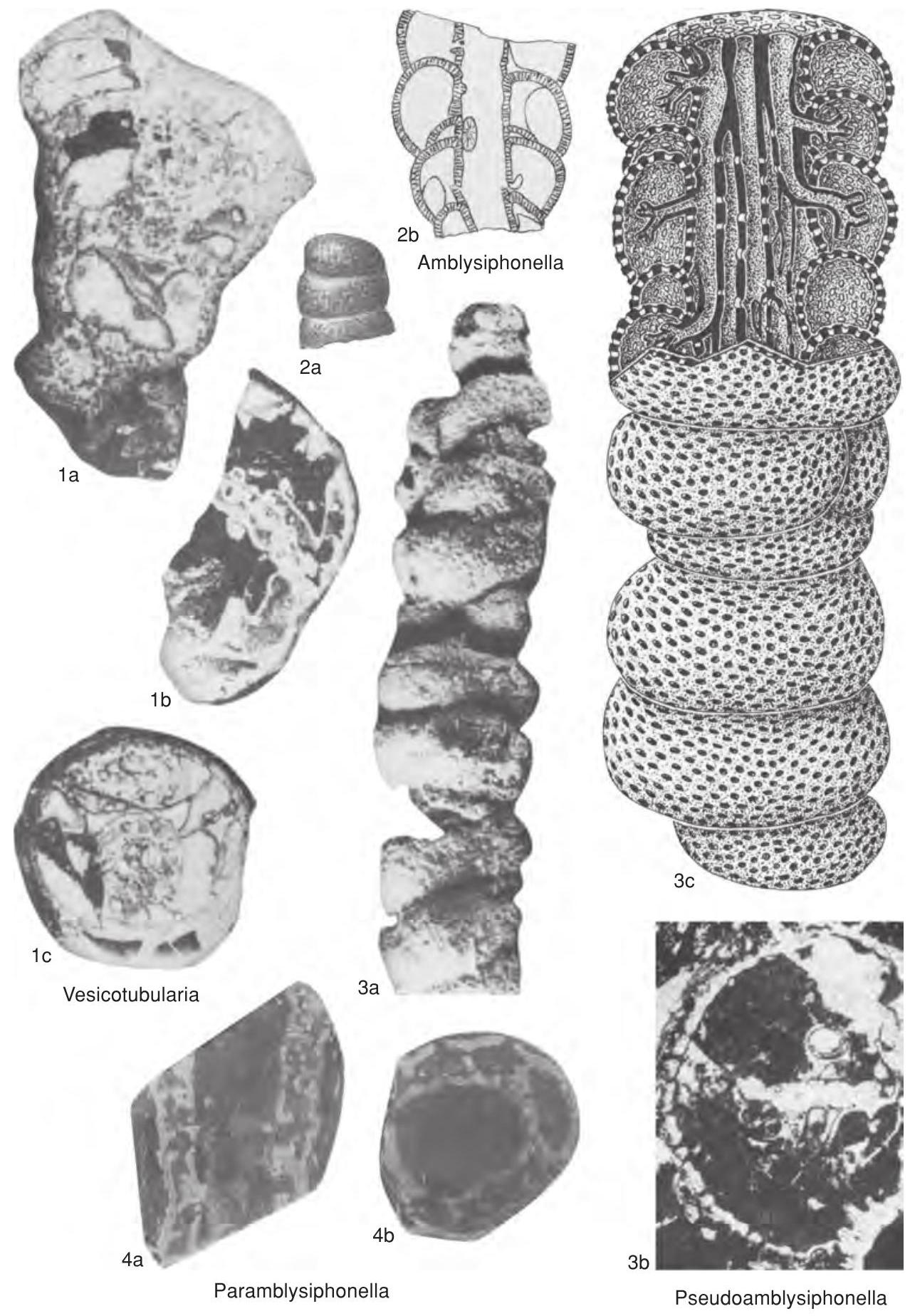 Fig. 448, 2a-b. *A. barroisi, Carboniferous limestone, Sebargas, Asturia, northwestern Spain, a, side view of type specimen, X1, b, longitudinal section showing porous chambers with scattered vesiculae, around perforate tubular spongocoel, exowalls and interwalls are also finely and uniformly perforate, X2 (Steinmann, 1882).
Synonyms
Laccosiphonella, Sebargasia, Paramblysiphonella, Lingyunocoelia
Geographic Distribution
Australia, ?Cambrian, USA (California), ?Ordovician, Kyrgyzstan, Carboniferous, Spain, China, Austria, Bashkirian, Moscovian, USA (Texas), Upper Pennsylvanian, Japan, China, USA (Texas, New Mexico), Tunisia, Italy (?Sicily), Oman, Tajikistan, Armenia, Permian, USA (Oregon), Italy (Sicily), Greece, Iran, Indonesia, China, Peru, Tajikistan, Russia (Caucasus region), Triassic
Age Range
Beginning Stage in Treatise Usage:
Cambrian
Beginning International Stage:
Fortunian
Fraction Up In Beginning Stage:
0
Beginning Date:
538.8
Ending Stage in Treatise Usage:
Triassic
Ending International Stage:
Rhaetian
Fraction Up In Ending Stage:
100
Ending Date:
201.36
Description
Cylindrical, sometimes subparallel branched segments correspond externally to interior chambers that are in linear series, central cloaca about one-third sponge diameter, exowall with numerous small, circular, closely spaced exopores, interwall a continuation of exowall, below, with similar pores, endowall somewhat thinner and endopores somewhat larger and more widely spaced, interior of chamber and sometimes cloaca may contain imperforate vesicles, wall microstructure small, isodiametric spherulites that may expand asymmetrically into lumens of pore canals and chambers, no spicules known except for a single, possible triradiate (Van De Graaf, 1969, pl. 2, 2) that may be foreign. [Because of homeomorphy, the range and distribution are uncertain; the genus should be used only for spherulitic, aspicular forms with only vesicles, and no trabeculae, in the chamber interiors. Sebargasia STEINMANN, 1882, differs chiefly in its fewer, larger endopores, and its smaller exopores; it should probably be considered a junior (page priority) synonym.]
References
Museum or Author Information
Classification
Phylum:
Porifera
Subphylum:
Gelatinosa
Class:
Demospongea
Subclass:
Ceractinomorpha
Order:
Agelasida
Family:
Sebargasiidae
Formal Genus Name and Reference:
Amblysiphonella STEINMANN, 1882, p. 169
Type Species:
A. barroisi STEINMANN, 1882, p. 170, OD
Images
(Click to enlarge in a new window)
Fig. 448, 2a-b. *A. barroisi, Carboniferous limestone, Sebargas, Asturia, northwestern Spain, a, side view of type specimen, X1, b, longitudinal section showing porous chambers with scattered vesiculae, around perforate tubular spongocoel, exowalls and interwalls are also finely and uniformly perforate, X2 (Steinmann, 1882).
Synonyms
Laccosiphonella, Sebargasia, Paramblysiphonella, Lingyunocoelia
Geographic Distribution
Australia, ?Cambrian, USA (California), ?Ordovician, Kyrgyzstan, Carboniferous, Spain, China, Austria, Bashkirian, Moscovian, USA (Texas), Upper Pennsylvanian, Japan, China, USA (Texas, New Mexico), Tunisia, Italy (?Sicily), Oman, Tajikistan, Armenia, Permian, USA (Oregon), Italy (Sicily), Greece, Iran, Indonesia, China, Peru, Tajikistan, Russia (Caucasus region), Triassic
Age Range
Beginning Stage in Treatise Usage:
Cambrian
Beginning International Stage:
Fortunian
Fraction Up In Beginning Stage:
0
Beginning Date:
538.8
Ending Stage in Treatise Usage:
Triassic
Ending International Stage:
Rhaetian
Fraction Up In Ending Stage:
100
Ending Date:
201.36
Description
Cylindrical, sometimes subparallel branched segments correspond externally to interior chambers that are in linear series, central cloaca about one-third sponge diameter, exowall with numerous small, circular, closely spaced exopores, interwall a continuation of exowall, below, with similar pores, endowall somewhat thinner and endopores somewhat larger and more widely spaced, interior of chamber and sometimes cloaca may contain imperforate vesicles, wall microstructure small, isodiametric spherulites that may expand asymmetrically into lumens of pore canals and chambers, no spicules known except for a single, possible triradiate (Van De Graaf, 1969, pl. 2, 2) that may be foreign. [Because of homeomorphy, the range and distribution are uncertain; the genus should be used only for spherulitic, aspicular forms with only vesicles, and no trabeculae, in the chamber interiors. Sebargasia STEINMANN, 1882, differs chiefly in its fewer, larger endopores, and its smaller exopores; it should probably be considered a junior (page priority) synonym.]