
Welcome to the Porifera subsite on Invertebrate Paleontology!
Please enter a genera name to retrieve more information.
Caminus
Classification
Phylum:
Porifera
Class:
Demospongea
Subclass:
Choristida
Order:
Ancorinida
Family:
Geodiidae
Subfamily:
Geodiinae
Formal Genus Name and Reference:
Caminus SCHMIDT, 1862, p. 48
Type Species:
C. vulcani, OD
Images
(Click to enlarge in a new window)
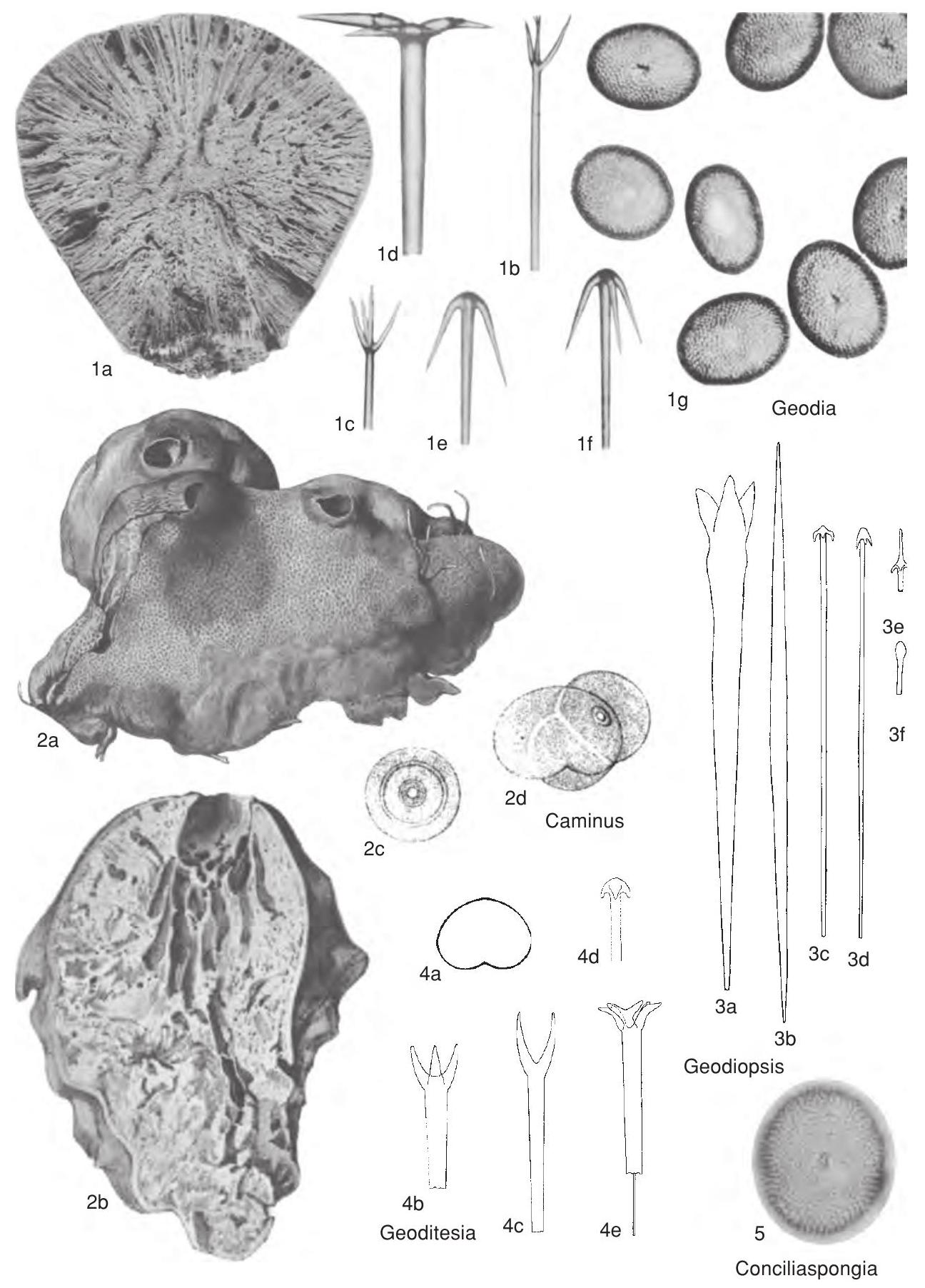 Fig. 131, 2a-d. C. sphaeroconia Sollas, Holocene, Brazil, South Atlantic; a, side view of complete sponge, X0.5; b, vertical section showing exhalant canals and paragastral cavity, X1; c, exceptionally large, somal sphere; d, compounded spheres, X400 (Sollas, 1888).
Synonyms
Geographic Distribution
Czech Republic, Slovakia, England (supposed records based on loose megascleres), ?Turonian-?Maastrichtian; Western Australia, Eocene; cosmopolitan, Holocene.
Age Range
Beginning Stage in Treatise Usage:
Upper Cretaceous (?Turonian)
Beginning International Stage:
Turonian
Fraction Up In Beginning Stage:
0
Beginning Date:
93.9
Ending Stage in Treatise Usage:
Holocene
Ending International Stage:
Meghalayan
Fraction Up In Ending Stage:
100
Ending Date:
0
Description
Globular to massive or lobate, inhalant chones as in Geodia, but exhalant water leaving through oscula of a few local, paragastral cavities, typical megascleres strongyles and orthotriaenes, but latter may be varied as dichotriaenes and strongyles may grade into oxea or amphitylote variants, no anatriaenes, accessory microscleres euasters and spheres or spheres only.
References
Schmidt, Oscar. 1862. Die Spongien des adriatischen Meeres. Wilhelm Engelmann. Leipzig. 88 p., 7 pl.
Museum or Author Information
Classification
Phylum:
Porifera
Class:
Demospongea
Subclass:
Choristida
Order:
Ancorinida
Family:
Geodiidae
Subfamily:
Geodiinae
Formal Genus Name and Reference:
Caminus SCHMIDT, 1862, p. 48
Type Species:
C. vulcani, OD
Images
(Click to enlarge in a new window)
Fig. 131, 2a-d. C. sphaeroconia Sollas, Holocene, Brazil, South Atlantic; a, side view of complete sponge, X0.5; b, vertical section showing exhalant canals and paragastral cavity, X1; c, exceptionally large, somal sphere; d, compounded spheres, X400 (Sollas, 1888).
Synonyms
Geographic Distribution
Czech Republic, Slovakia, England (supposed records based on loose megascleres), ?Turonian-?Maastrichtian; Western Australia, Eocene; cosmopolitan, Holocene.
Age Range
Beginning Stage in Treatise Usage:
Upper Cretaceous (?Turonian)
Beginning International Stage:
Turonian
Fraction Up In Beginning Stage:
0
Beginning Date:
93.9
Ending Stage in Treatise Usage:
Holocene
Ending International Stage:
Meghalayan
Fraction Up In Ending Stage:
100
Ending Date:
0
Description
Globular to massive or lobate, inhalant chones as in Geodia, but exhalant water leaving through oscula of a few local, paragastral cavities, typical megascleres strongyles and orthotriaenes, but latter may be varied as dichotriaenes and strongyles may grade into oxea or amphitylote variants, no anatriaenes, accessory microscleres euasters and spheres or spheres only.
References
Schmidt, Oscar. 1862. Die Spongien des adriatischen Meeres. Wilhelm Engelmann. Leipzig. 88 p., 7 pl.