
Welcome to the Porifera subsite on Invertebrate Paleontology!
Please enter a genera name to retrieve more information.

Carbonella
Classification
Phylum:
Porifera
Class:
Hexactinellida
Subclass:
Hexasterophora
Order:
Lyssacinosa
Superfamily:
Brachiospongioidea
Family:
Malumispongiidae
Formal Genus Name and Reference:
Carbonella Hurcewicz & CZARNIECKI, 1986, p. 341
Type Species:
C. rotunda, OD
Images
(Click to enlarge in a new window)
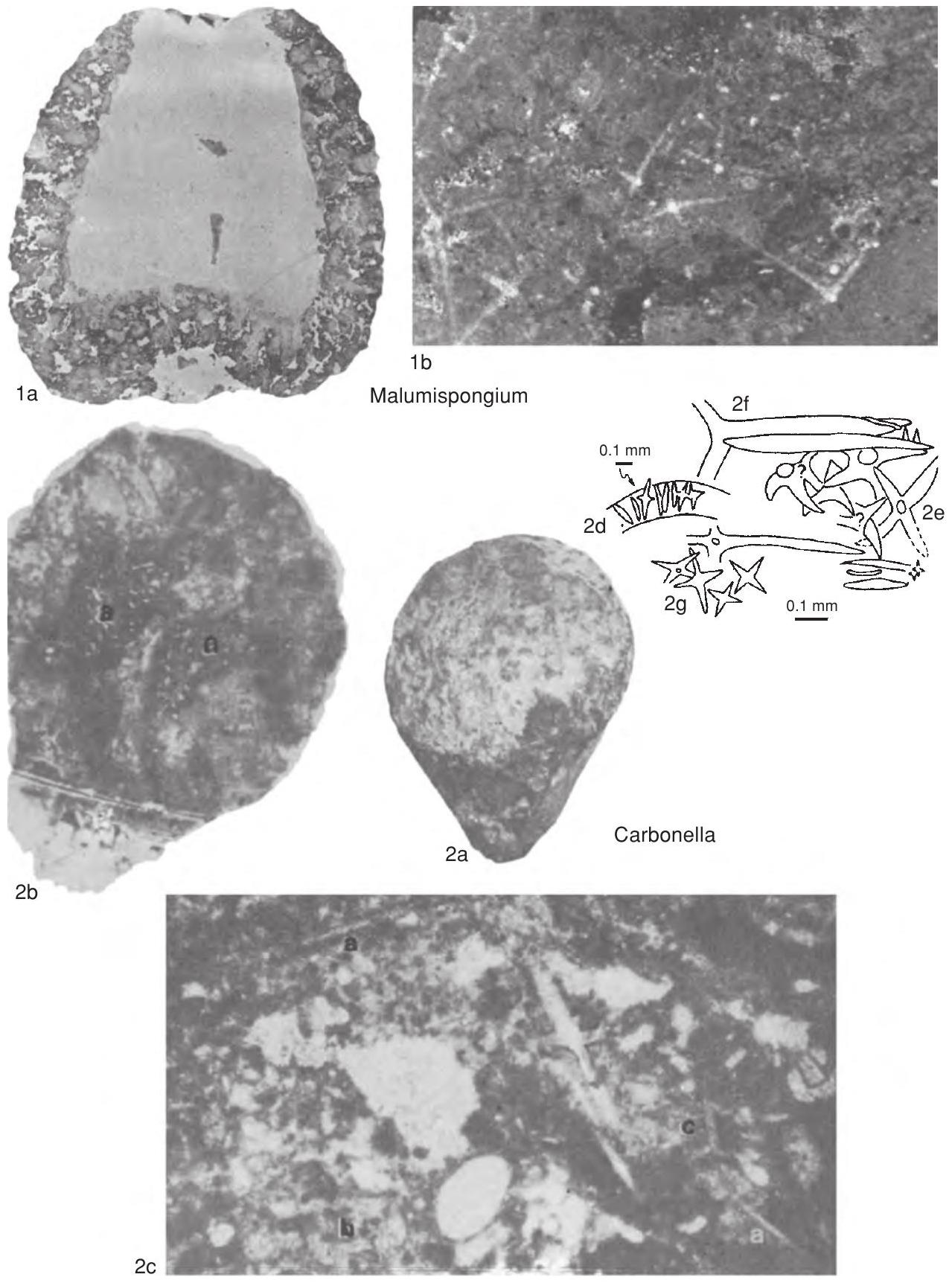 Fig. 279, 2a-g. *C. rotunda, Carboniferous limestone of Galezice, Holy Cross Mountains; a, side view of holotype, X0.5; b, longitudinal section showing cribrate, skeletal structure, X1; c, skeletal fragment with diactine ( a ), stauractine ( b ), and larger hexactines with axial rays (c), X100, d-g, drawing of spicules from thin section; d-e, stauractines and diactines in dermal skeleton; f, hexactines and stauractines in endosomal skeleton; g, diactines, scale bar, 0.1 mm , AI-68/32 (Hurcewicz & Czarniecki, 1986, courtesy of Polish Geological Society, Krakow).
Synonyms
Geographic Distribution
Poland
Age Range
Beginning Stage in Treatise Usage:
Carboniferous (Visean)
Beginning International Stage:
Visean
Fraction Up In Beginning Stage:
0
Beginning Date:
346.73
Ending Stage in Treatise Usage:
Carboniferous (Visean)
Ending International Stage:
Visean
Fraction Up In Ending Stage:
100
Ending Date:
330.34
Description
Spheroidal to pyriform, thick walled, outer surface with irregularly distributed, low protuberances, no osculum; cloaca narrow and of stellate cross section (because of entering possible canals); canals of circular cross section, closely spaced in more or less quincuncial arrangement, open on exterior; dermal skeleton of small stauractines and rhabdodiactines; principal skeleton of larger hexactines and stauractines, including irregularly distributed, much larger ones; gastral layer containing vertically oriented rhabdodiactines.
References
Hurcewicz, H., \& S. Czarniecki. 1986. Lyssakidae sponges from the Carboniferous limestone and the Culm of southern Poland and their environmental differentiation. Annales Societatis Geologorum Poloniae 55:333-354, fig. 1-18, pl. I-IX.
Museum or Author Information
Classification
Phylum:
Porifera
Class:
Hexactinellida
Subclass:
Hexasterophora
Order:
Lyssacinosa
Superfamily:
Brachiospongioidea
Family:
Malumispongiidae
Formal Genus Name and Reference:
Carbonella Hurcewicz & CZARNIECKI, 1986, p. 341
Type Species:
C. rotunda, OD
Images
(Click to enlarge in a new window)
Fig. 279, 2a-g. *C. rotunda, Carboniferous limestone of Galezice, Holy Cross Mountains; a, side view of holotype, X0.5; b, longitudinal section showing cribrate, skeletal structure, X1; c, skeletal fragment with diactine ( a ), stauractine ( b ), and larger hexactines with axial rays (c), X100, d-g, drawing of spicules from thin section; d-e, stauractines and diactines in dermal skeleton; f, hexactines and stauractines in endosomal skeleton; g, diactines, scale bar, 0.1 mm , AI-68/32 (Hurcewicz & Czarniecki, 1986, courtesy of Polish Geological Society, Krakow).
Synonyms
Geographic Distribution
Poland
Age Range
Beginning Stage in Treatise Usage:
Carboniferous (Visean)
Beginning International Stage:
Visean
Fraction Up In Beginning Stage:
0
Beginning Date:
346.73
Ending Stage in Treatise Usage:
Carboniferous (Visean)
Ending International Stage:
Visean
Fraction Up In Ending Stage:
100
Ending Date:
330.34
Description
Spheroidal to pyriform, thick walled, outer surface with irregularly distributed, low protuberances, no osculum; cloaca narrow and of stellate cross section (because of entering possible canals); canals of circular cross section, closely spaced in more or less quincuncial arrangement, open on exterior; dermal skeleton of small stauractines and rhabdodiactines; principal skeleton of larger hexactines and stauractines, including irregularly distributed, much larger ones; gastral layer containing vertically oriented rhabdodiactines.
References
Hurcewicz, H., \& S. Czarniecki. 1986. Lyssakidae sponges from the Carboniferous limestone and the Culm of southern Poland and their environmental differentiation. Annales Societatis Geologorum Poloniae 55:333-354, fig. 1-18, pl. I-IX.