
Welcome to the Porifera subsite on Invertebrate Paleontology!
Please enter a genera name to retrieve more information.
Eiffelia
Classification
Phylum:
Porifera
Class:
Heteractinida
Order:
Octactinellida
Family:
Eiffeliidae
Formal Genus Name and Reference:
Eiffelia WALCOTT, 1920, p. 323
Type Species:
*E. globosa WALCOTT, 1920, p. 324, OD
Images
(Click to enlarge in a new window)
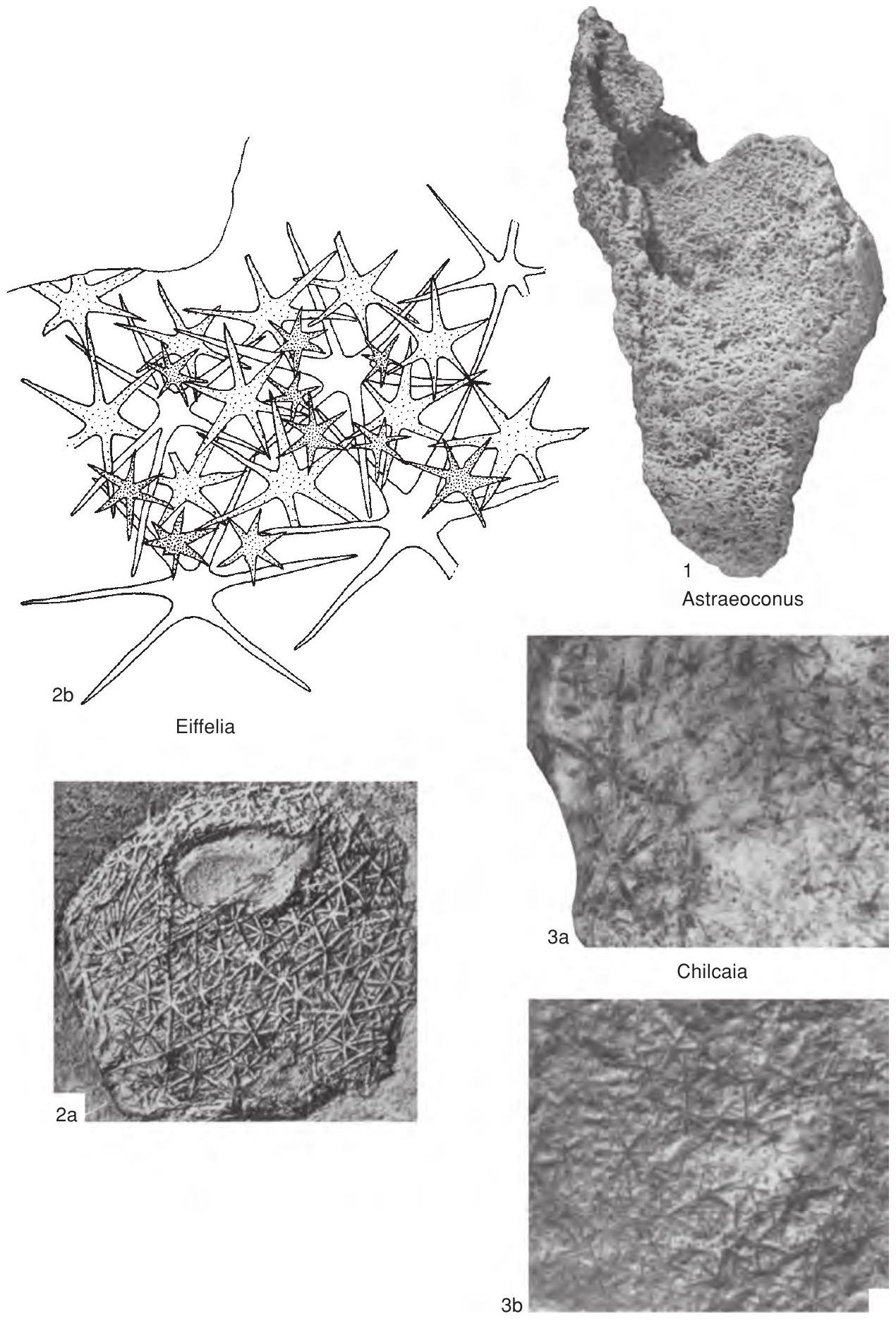 Fig. 372, 2a-b. *E. globosa, Stephen Formation, Albertan, Burgess Quarry, Mount Field, British Columbia, Canada; a, lectotype showing globose form, open osculum, and thin, skeletal net of ranked, sexiradiate spicules, ×3 (Walcott, 1920); b, camera lucida drawing of part of skeleton showing orientation and positions of ranked sexiradiates in lectotype, USNM 66522, ×3.7 (Rigby, 1986c).
Synonyms
Geographic Distribution
Siberian Platform, Mongolia, China, Europe, Africa, Australia, Canada, USA
Age Range
Beginning Stage in Treatise Usage:
Lower Cambrian
Beginning International Stage:
Fortunian
Fraction Up In Beginning Stage:
0
Beginning Date:
538.8
Ending Stage in Treatise Usage:
Middle Cambrian
Ending International Stage:
Guzhangian
Fraction Up In Ending Stage:
50
Ending Date:
498.75
Description
Globose, thin-walled sponges with circular osculum, oscular rim enrolled or situated in shallow depression, body wall supported by one or few layers of spicules of at least four size orders, arranged so succeeding orders occur between rays of immediately larger orders, spicules with six long, evenly spaced, thin, tapering rays tangential or reflexed to sponge surface, it is not certain whether seventh, inwardly directed ray was present, spicules regularly and quincuncially arranged and contratangent so that rays outline triangular interspaces.
References
Walcott, C. D. 1920. Cambrian Geology and Paleontology. IV. no. 6. Middle Cambrian Spongiae. Smithsonian Miscellaneous Collections 67(6):261-364, fig. 4-10, pl. 60-90.
Museum or Author Information
Classification
Phylum:
Porifera
Class:
Heteractinida
Order:
Octactinellida
Family:
Eiffeliidae
Formal Genus Name and Reference:
Eiffelia WALCOTT, 1920, p. 323
Type Species:
*E. globosa WALCOTT, 1920, p. 324, OD
Images
(Click to enlarge in a new window)
Fig. 372, 2a-b. *E. globosa, Stephen Formation, Albertan, Burgess Quarry, Mount Field, British Columbia, Canada; a, lectotype showing globose form, open osculum, and thin, skeletal net of ranked, sexiradiate spicules, ×3 (Walcott, 1920); b, camera lucida drawing of part of skeleton showing orientation and positions of ranked sexiradiates in lectotype, USNM 66522, ×3.7 (Rigby, 1986c).
Synonyms
Geographic Distribution
Siberian Platform, Mongolia, China, Europe, Africa, Australia, Canada, USA
Age Range
Beginning Stage in Treatise Usage:
Lower Cambrian
Beginning International Stage:
Fortunian
Fraction Up In Beginning Stage:
0
Beginning Date:
538.8
Ending Stage in Treatise Usage:
Middle Cambrian
Ending International Stage:
Guzhangian
Fraction Up In Ending Stage:
50
Ending Date:
498.75
Description
Globose, thin-walled sponges with circular osculum, oscular rim enrolled or situated in shallow depression, body wall supported by one or few layers of spicules of at least four size orders, arranged so succeeding orders occur between rays of immediately larger orders, spicules with six long, evenly spaced, thin, tapering rays tangential or reflexed to sponge surface, it is not certain whether seventh, inwardly directed ray was present, spicules regularly and quincuncially arranged and contratangent so that rays outline triangular interspaces.
References
Walcott, C. D. 1920. Cambrian Geology and Paleontology. IV. no. 6. Middle Cambrian Spongiae. Smithsonian Miscellaneous Collections 67(6):261-364, fig. 4-10, pl. 60-90.