
Welcome to the Porifera subsite on Invertebrate Paleontology!
Please enter a genera name to retrieve more information.

Kiwetinokia
Classification
Phylum:
Porifera
Class:
Hexactinellida
Subclass:
Amphidiscophora
Order:
Reticulosa
Superfamily:
Protospongioidea
Family:
Protospongiidae
Formal Genus Name and Reference:
Kiwetinokia WALCOTT, 1920, p. 311
Type Species:
K. utahensis WALCOTT, 1920, p. 313, OD
Images
(Click to enlarge in a new window)
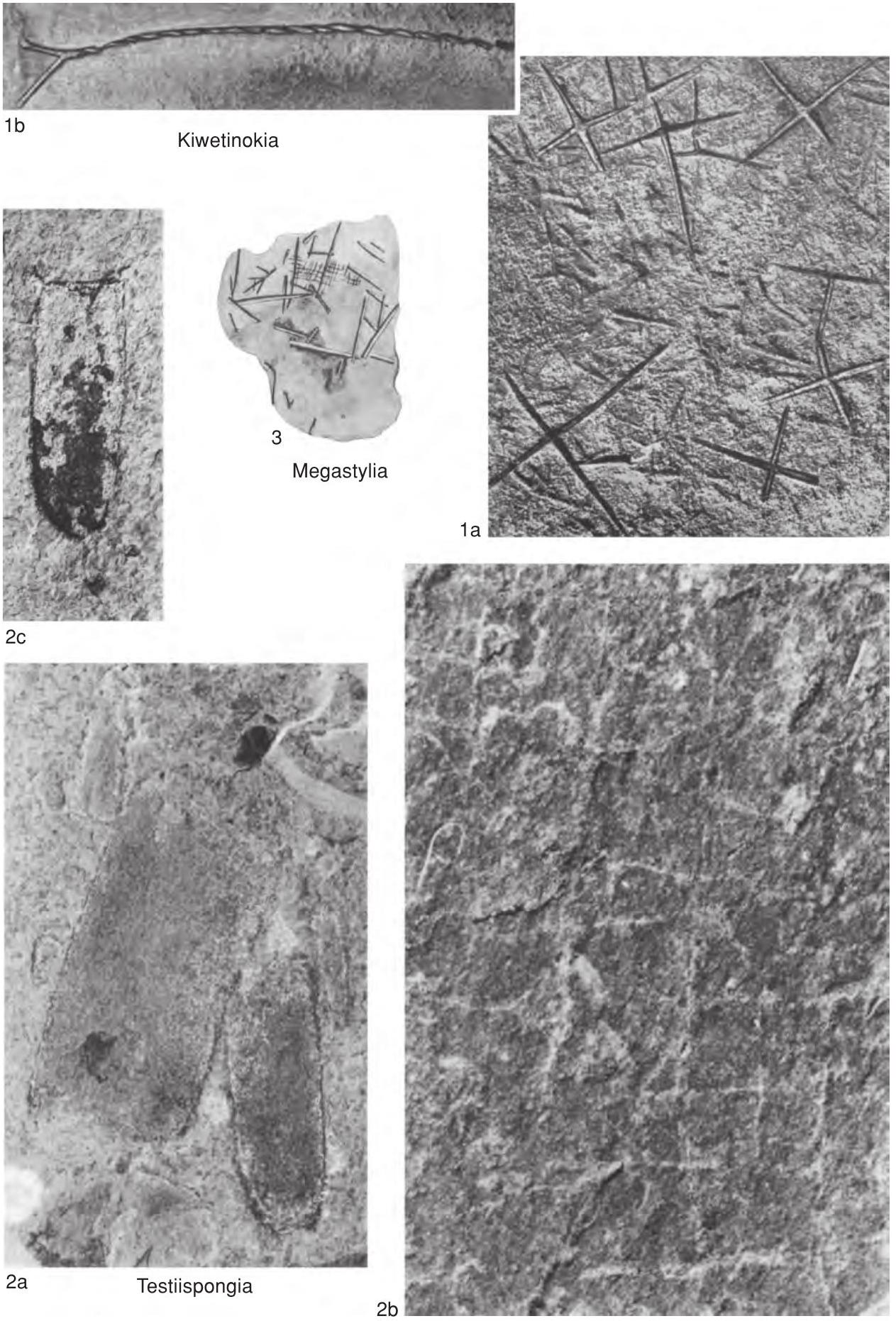 Fig. 224, 1a-b. *K. utahensis, Marjum Limestone, House Range, Utah; a, photomicrograph of strew of stauractines in lectotype; b, rod formed of twisted diactine in lectotype fragment, USNM 66542, X2 (Walcott, 1920).
Synonyms
Geographic Distribution
USA (Utah), Canada (Quebec), Argentina
Age Range
Beginning Stage in Treatise Usage:
Middle Cambrian
Beginning International Stage:
Cambrian Stage 4
Fraction Up In Beginning Stage:
40
Beginning Date:
512.3
Ending Stage in Treatise Usage:
Middle Cambrian
Ending International Stage:
Guzhangian
Fraction Up In Ending Stage:
50
Ending Date:
498.75
Description
The type species consists of scattered stauractines, tauactines, and two possible rhabdodiactines twisted together spirally. [K. spiralis W ALCOTT and K. metissica (D AWSON , 1889) consist of similar spicules with cablelike rods apparently of a half-dozen or so rhabdodiactines twisted together. H INDE (1893a) considered the cablelike spicules called Hyalostelia metissica by DAWSON (1889) to be possibly the root tufts of co-occurring Palaeosaccus, an opinion subsequently concurred with by D AWSON (1896, p. 108). Kiwetinokia could be considered a junior subjective synonym of Palaeosaccus.]
References
Walcott, C. D. 1920. Cambrian Geology and Paleontology. IV. no. 6. Middle Cambrian Spongiae. Smithsonian Miscellaneous Collections 67(6):261-364, fig. 4-10, pl. 60-90.
Museum or Author Information
Classification
Phylum:
Porifera
Class:
Hexactinellida
Subclass:
Amphidiscophora
Order:
Reticulosa
Superfamily:
Protospongioidea
Family:
Protospongiidae
Formal Genus Name and Reference:
Kiwetinokia WALCOTT, 1920, p. 311
Type Species:
K. utahensis WALCOTT, 1920, p. 313, OD
Images
(Click to enlarge in a new window)
Fig. 224, 1a-b. *K. utahensis, Marjum Limestone, House Range, Utah; a, photomicrograph of strew of stauractines in lectotype; b, rod formed of twisted diactine in lectotype fragment, USNM 66542, X2 (Walcott, 1920).
Synonyms
Geographic Distribution
USA (Utah), Canada (Quebec), Argentina
Age Range
Beginning Stage in Treatise Usage:
Middle Cambrian
Beginning International Stage:
Cambrian Stage 4
Fraction Up In Beginning Stage:
40
Beginning Date:
512.3
Ending Stage in Treatise Usage:
Middle Cambrian
Ending International Stage:
Guzhangian
Fraction Up In Ending Stage:
50
Ending Date:
498.75
Description
The type species consists of scattered stauractines, tauactines, and two possible rhabdodiactines twisted together spirally. [K. spiralis W ALCOTT and K. metissica (D AWSON , 1889) consist of similar spicules with cablelike rods apparently of a half-dozen or so rhabdodiactines twisted together. H INDE (1893a) considered the cablelike spicules called Hyalostelia metissica by DAWSON (1889) to be possibly the root tufts of co-occurring Palaeosaccus, an opinion subsequently concurred with by D AWSON (1896, p. 108). Kiwetinokia could be considered a junior subjective synonym of Palaeosaccus.]
References
Walcott, C. D. 1920. Cambrian Geology and Paleontology. IV. no. 6. Middle Cambrian Spongiae. Smithsonian Miscellaneous Collections 67(6):261-364, fig. 4-10, pl. 60-90.